
This project was undertaken as part of my MRes, pertaining to the ‘Geographies of Life’ module. The inclusive word limit is 1000 words [998/1000], with the blog trying to both extend critical debates around networked life and provide a platform for the development of projects. The post is referenced, with some hyperlinks included where appropriate.
From ‘HAL-9000’ in 2001: A Space Odyssey [1968], ‘Proteus IV’ in Demon Seed [1977], to ‘Samantha’ in Her [2013] [1], so-called ‘smart’ technological devices within the home have been idolised, prophesised and vilified in various works of fiction. With major advances in computing power over the last 30 years in particular, devices which were once confined to discussions between screenwriters and set designers in Hollywood studios became common-place in 21st century homes; with numerous consumer websites noting the “12 Must-Have Devices To Transform Your House Into A Smart Home” [2].
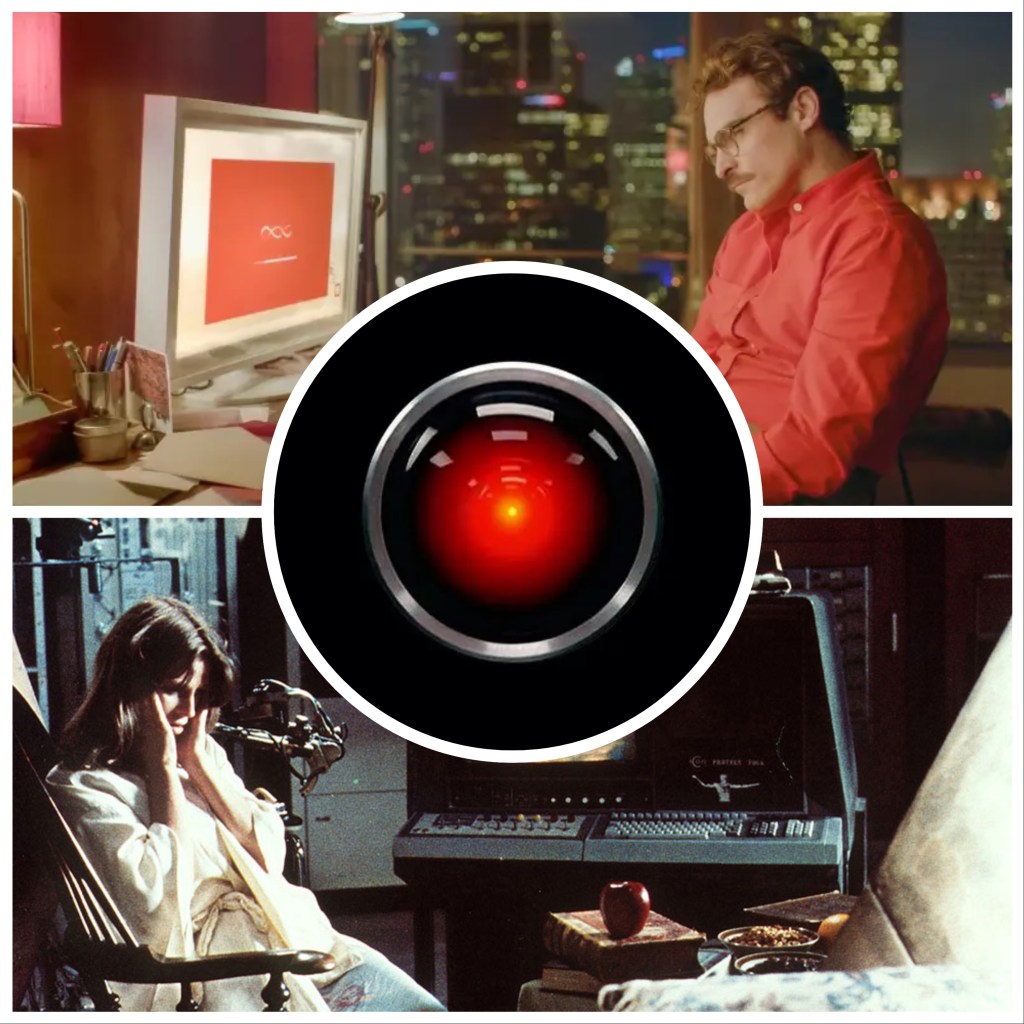
Figure 1: A collage of ‘HAL-9000’, ‘Proteus IV’ & ‘Samantha’. Made from screenshots from reference [1].
This process, termed ‘diegetic prototyping’ by David Kirby [3], has accelerated the production and adoption of smart technologies and their associated networks into everyday life. Increasingly, homes are being designed with smart integration in mind [4], yet there remains a rapidly growing market of non-intrusive technologies which can be installed in every home [5]. The purpose of this blog is two-fold: elucidate the various relational and intersecting networks which smart devices create, and understand what æffect[s] [6] this has on the everyday geographies of the ‘home’ and holistic ‘home life’. Fundamentally, the drive towards enhanced smart technology integration is framed as generally positive by both media and consumers alike, evidenced through the ever-increasing sales and articles explaining “why you should be building smart homes” [7]. However, I call for greater investigation into this area, understanding how the socio-political co-construction of the ‘home’ is influenced and modified by increasingly networked lives and, by often obscured, digital processes. To begin, let’s explore what the notion of ‘smart’ actually means…
‘Smart’ Technologies?
Given the widespread usage of the term, the notion of a ‘smart’ technological device has become an ill-defined marketing buzzword to increase consumer sales [8]. James Ash discusses this in his book ‘Phase Media’, yet he is keen to cement the fundamental aspects which make a device ‘smart’: Self-Monitoring, Analysis, and Reporting Technology. Such devices allow for remote connection and customised user experiences, ranging from ‘smart connected’ devices which allow for mediated human control or Internet of Things [IoT] devices which operate automatically without the need for human intervention [9]. When paired with artificial intelligence [AI], cloud connectivity and machine learning algorithms, previously inanimate objects are given a form of “cognitive awareness”, continuously learning to adapt to, modify and effect everyday human behaviours [10].
Motivated by technological and economic desires for the integration of computing power into all devices, explored through the various literature on ubiquitous computing [11], smart technologies have been rapidly adopted into all areas of home life. This notion of universal smart integration is bound up with socially constructed definitions of futurity, and what types of technology are associated with our continued development [12]. Depending on who you ask, this may be driven by attempts to actualise fictional depictions [13] or to satisfy the aspirations of Silicon Valley research and development departments [14]. Nevertheless, smart technologies are becoming increasingly prevalent in all areas of the home, ranging from the more understandable automated thermostat/central heating and security systems to the fundamentally bizarre ‘Dog Treat Tossers’ and ‘Smart Mosquito Repellent Systems’ [15] [16].
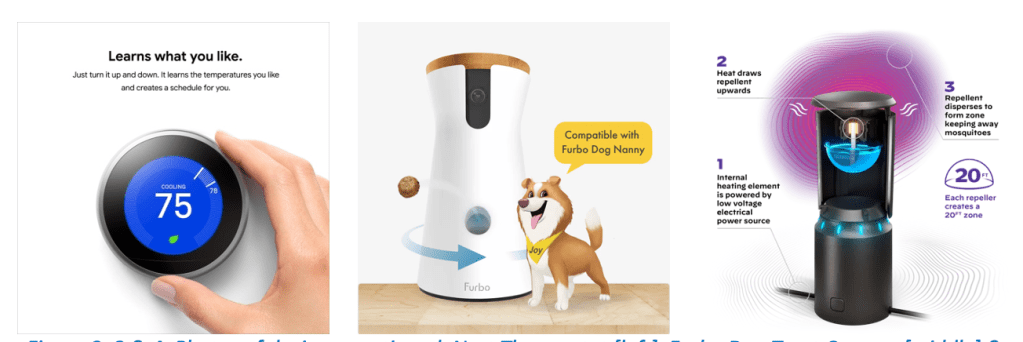
Figure 2, 3 & 4: Photos of devices mentioned, Nest Thermostat [left], Furbo Dog Treat Camera [middle] & Thermacell LIV Smart Mosquito Repellent [right]. See source [15].
With such technologies establishing themselves in traditionally private areas of everyday home life [17], geographers have become increasingly interested in the various types of networked life that are now formed by and/or dependent on digital processes. Theoretically, more-than-human approaches have de-centred the human from the nexus of network analysis [18], opening discussion over the æffective power that digital technologies have over our existence. In doing so, smart technologies have become bound up in the Latourian/Callonian tradition of ‘Actor Network Theory’ [19], where various human and non-human actors can both influence others and be influenced themselves. With respect to the devices discussed, their ability to modify human life through the analysis of imperceptible data creates influential networks outside of human perception, and sometimes human control. To Ash, “what smart objects do should primarily be understood in terms of the qualities they disclose outside of the realms of human sense” [20], with new relationships and data influencing the everyday spatialities of the home.
The ‘Smart Home’ & A Call For Research:
With the ‘home’ already regarded as “an important and complex phenomenon” within geography [21], such rapid introduction of smart technologies has the capacity to rapidly transform the construction of traditionally analogue networks associated with the home [22]. Nevertheless, the current literature adopts a largely non-critical approach, simply exploring the positive benefits of smart home integration in the fields of sustainability [23], security [24], home entertainment [ibid.] inter alia. To build on this body of literature, I propose two vectors of investigation: ‘the home & private spaces’ and ‘the home & care’.
The Home & Private Spaces:
Building on Habermasean literature regarding the digitisation of public space [25], the hybrid private/public networks which smart technologies are reliant upon have become a point of issue for many consumers. Issues surrounding privacy and the digitisation of spaces of the home has been a major barrier to consumer uptake [26], with frequent concerns vocalised over data breaches and hacking [ibid.]. The potential for disruption of these networks further complicates their usage, potentially re-defining the already complex divide between public and private life.
The Home & Care:
In neo-liberal times, notions of ‘care’ have become increasingly atomised, with the onus placed on individual households to provide self-care [27]. However, with the introduction of smart devices, aspects of care are becoming wrapped up in wider trans-social networks which de-centralise care [28]. Understanding the impact that automated and digital care has on power relations and home identities is important, linking with wider feminist literature on unremunerated care at home [29].
These two lines of analysis are by no means exhaustive; simply providing potential ideas for research based on reflexive examination of both my engagement with smart technologies and associated literatures. If anything, I hope this blog invites you to question the role of smart technologies in your own life, alongside the many concerns and issues with which such hybrid networks are entangled with.
References & Sources:
Formatting the references on WordPress proved more difficult than first anticipated…
Instead, a PDF document is attached with the references formatted in a much more accessible way. Apologies!
An additional PDF of the whole submission is available below, thanks!
 Tommy Nagle
Leave a comment